
Padel vs Tennis: Differences, Rules and Which to Play
The courts are closer in size than you might think. The bigger adjustment is what happens after a good shot hits the glass.
GuideBy PadelFormat Editorial TeamPublished 11 min read
Quick answer
If you already play tennis, you have a useful head start. Learning when to leave the ball alone may be your first challenge.
TL;DR
- Padel's playing area is slightly larger than tennis singles, but smaller than tennis doubles. The calculation below excludes the surrounds.
- The ball specifications overlap. Padel balls are not universally lighter than tennis balls.
- Tennis experience helps with hitting and movement. Compact preparation, wall reads and moving with your partner need separate practice.
- Choose around the game you enjoy and the sessions you can actually attend. A convenient weekly booking matters more than a theoretical ranking of the two sports.
On this page
Padel vs tennis at a glance
| Feature | Padel | Tennis |
|---|---|---|
| Standard format | Doubles | Singles or doubles |
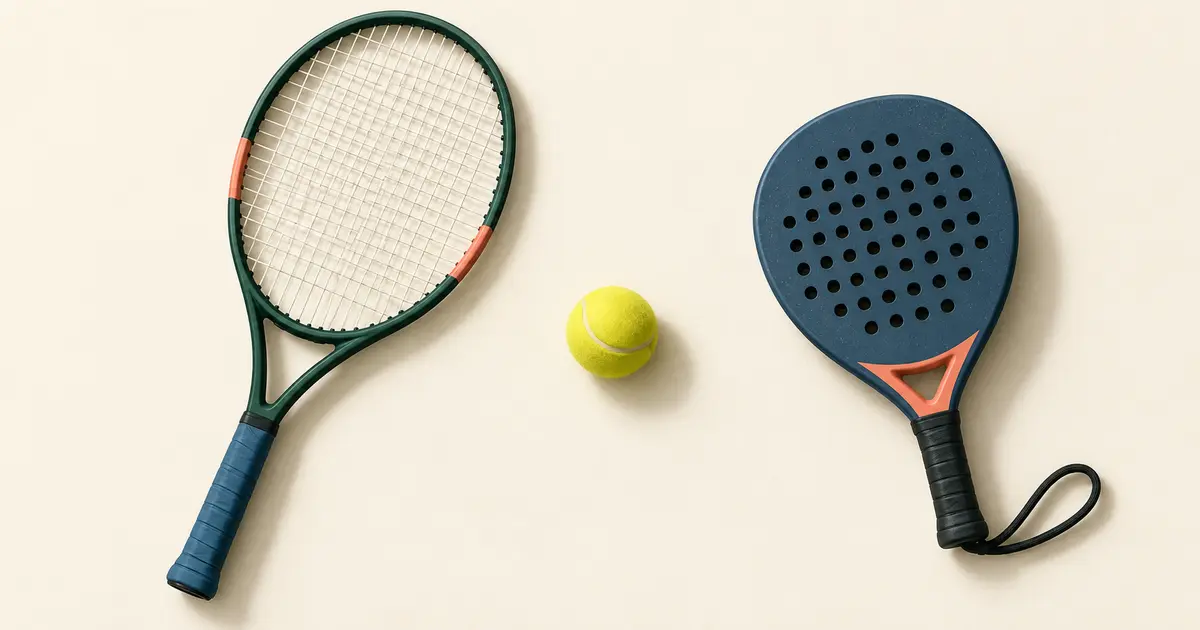
| Racket | Short, perforated face | Longer frame with strings |
| Serve | Underarm, after a bounce | Usually overhead, before a bounce. Underarm is also legal |
| Walls | Playable after the appropriate court bounce | No playable wall rebounds |
| Usual score | 15, 30, 40, games and sets | 15, 30, 40, games and sets |
| Main adjustment for a tennis player | Reading rebounds and choosing shots around them | Familiar court and ball behaviour |
Is a padel court smaller than a tennis court?
A padel court is shorter than a tennis court but wider than the singles court.
| Court | Length | Width | Playing area |
|---|---|---|---|
| Padel, inside the enclosure | 20 m | 10 m | 200 m² |
| Tennis singles, inside the lines | 23.77 m | 8.23 m | 195.63 m² |
| Tennis doubles, inside the lines | 23.77 m | 10.97 m | 260.76 m² |
Padel dimensions are confirmed by the LTA, and tennis dimensions by the ITF.12 Areas are PadelFormat calculations, rounded to two decimal places.
Padel has about 2.2% more playing area than tennis singles and 23.3% less than tennis doubles.
The calculations are (200 ÷ 195.6271 − 1) × 100 and (1 − 200 ÷ 260.7569) × 100, using the published metric dimensions.
That does not mean a padel facility needs more land than a singles tennis facility. Tennis needs space outside the lines for players to chase the ball. Padel's enclosure forms part of the game, and a facility still needs access and appropriate clearance.
For a fuller explanation of the enclosure and surrounding space, see padel court dimensions.
Are padel balls different from tennis balls?
Yes, but “smaller, lighter and much less bouncy” is too sweeping. The specifications overlap.
| Specification | Standard padel ball | ITF Type 2 tennis ball |
|---|---|---|
| Permitted mass | 56.0–59.4 g | 56.0–59.4 g |
| Permitted diameter | 6.35–6.77 cm | 6.54–6.86 cm |
| Specified rebound | 135–145 cm | 135–147 cm |
Sources: FIP Rules of Padel and the ITF 2026 Technical Booklet.45 Both specify a rebound test using a drop of approximately 2.54 metres onto a hard surface. This table excludes high-altitude and beginner tennis balls.
The weight ranges are identical. The diameter ranges overlap, and the entire padel rebound range falls inside the Type 2 tennis range. Those are comparisons of the permitted specifications, not results from testing balls on court.
You cannot use them to calculate a universal percentage difference in playing speed. They also do not establish that a particular tennis ball is approved for padel.
For your booking, bring balls sold for padel or use the club's recommended balls. FIP competitions require FIP-approved balls.
The serve changes how you start the point
In padel, bounce the ball behind the service line, then strike it at or below waist height into the diagonal service box. In tennis, release the ball and hit it before it bounces. An overhead action is conventional, but an underarm tennis serve is legal.24
Both sports allow a second serve after a fault. The receiver must let the serve bounce. Once it has been returned, either team can volley.
For a tennis player, the practical adjustment is what happens next. The serving padel pair normally tries to take the net together. Serve at a pace that gives you time to join your partner and settle before the return arrives.
A fast serve has achieved little if it leaves you running forwards while the ball is already at your feet.
The glass changes which shots are good
An opponent's shot can bounce in your court, hit the glass and remain playable. You must return it before its second floor bounce. A shot that hits your glass before landing in your court is out.3
That creates two unfamiliar decisions.
First, a deep incoming ball may become easier after the rebound. Reaching backwards to catch it early can turn a comfortable return into a cramped swing. You need to judge whether it has enough pace to come away from the wall. A ball that dies close to the glass gives you much less room.
Second, hitting harder can help the defender. A drive that rebounds well away from the back glass may give them time and a comfortable contact point. The Padel School identifies excessive pace as a common tactical mistake and recommends varying it with lobs and controlled shots.7
Power still has a place. The useful question is where the opponent will make contact after your shot, including after the rebound.
Is the scoring the same?
The familiar 15, 30, 40 sequence carries over. Agree what happens at deuce before you start.
The current FIP rules provide Advantage, Star Point and Golden Point options. Tennis also permits alternatives such as no-ad scoring.24 Two matches using the same score calls can therefore settle deuce differently.
Our padel scoring guide explains the formats and tie-breaks. Use the format announced by your club or competition.
Which tennis skills transfer to padel?
Recognising the ball early, balancing before contact and finding the middle of the racket remain useful. So do volleys, lobs and knowing when an opponent is under pressure. The LTA identifies substantial overlap in the shots and movements.
The mistake is assuming that a familiar-looking ball deserves your familiar response.
Shorten the preparation when the ball is close
A full groundstroke backswing can leave you late near the glass or during a quick exchange. Prepare the racket earlier and keep enough space between the ball and your body to make clean contact.
The LTA's beginner guidance recommends a short backswing on both sides. Start your first rallies gently enough to notice where your preparation becomes rushed.
Use topspin for a reason
You do not need to abandon topspin. You do need more than one answer.
The Padel School recommends learning a flat forehand alongside it. Topspin can help a ball dip over the net, while a flat contact offers options for a controlled drive, a ball to the feet or a lob. A difficult rebound close to the back glass is a poor place to force your biggest topspin swing.8
Try choosing the target first. Then choose the contact that lets you reach it without rushing.
Judge the lob before committing to a smash
A deep lob can pull you away from the net. Trying to finish while still moving backwards risks an error or an inviting rebound. The Padel School advises judging the lob early and allowing a deep one to come off the back glass when appropriate.
For a first session, use a simple question: can you get behind this ball in balance? If you are still chasing it, give yourself time to defend. Learn the controlled overhead options in our padel shots guide.
Move with your partner
When one player attacks at the net while the other stays deep, opponents have different spaces to target. Learn to recognise when both of you can move forwards and when a good lob has forced you back.
The Padel School teaches coordinated forward and backward movement as a foundation of doubles positioning. You will see more complex arrangements in advanced play. Start by keeping track of your partner as well as the ball.
See padel positions and which side to play for the full explanation.
A useful first session for a tennis player
After warming up, spend twenty minutes practising the rebound, your preparation and moving forwards after serving. This is PadelFormat's suggested practice routine. The timings have not been tested as a training programme.
| Time | Practice | What to notice |
|---|---|---|
| Five minutes | Gentle rallies from the back | Whether a shorter preparation still gives you enough control |
| Five minutes | A partner feeds balls that clearly rebound from the back glass | How much space to leave so the rebound comes towards your hitting position |
| Five minutes | Serve, move forward and play a controlled return | Whether you arrive balanced before the next shot |
| Five minutes | Play points, then briefly discuss the final shot | Whether it caused a difficult contact or handed over an easy rebound |
Alternate the roles so both players practise the unfamiliar part. Ask a coach to help with the glass if you keep crowding it. There is little value in repeating twenty uncomfortable contacts without changing your position.
Is padel easier than tennis for beginners?
Getting a first rally going and becoming a strong player are different questions.
The underarm serve gives padel beginners a straightforward way to start points. The walls also give you opportunities to retrieve a ball after it has passed you. You still have to learn how to read them.
Tennis beginners do not have to start with the full-speed adult game. The LTA's Tennis Xpress programme uses modified equipment, including slower-bouncing balls, to help adults learn to serve and rally.
For a fair comparison, try a beginner session in each sport. A good coach, suitable balls and partners at your level can change the experience considerably. An expert opponent firing winners past you tells you little about how enjoyable either sport is to learn.
Which should you play?
Choose tennis if singles is a major part of the appeal. You can organise a match with one other person and take responsibility for the whole court. Doubles remains an option when you want a partner.
Choose padel if you like building points with a partner and want to learn the wall game. Check whether your nearest club offers beginner sessions or matched games. Those are useful if finding three other players is the main obstacle.
Before choosing, look at the actual sessions you could attend next week: their level, times, travel and price per player. Compare equal booking lengths and include any racket hire. A whole-court price split four ways cannot be compared directly with a two-player booking.
If you already enjoy tennis, book a padel introduction before buying equipment. Our guide to starting padel covers the first booking and what to bring.
Frequently asked questions
- Can you use a tennis racket for padel?
- No. Standard padel uses a short racket with a perforated face rather than strings. Borrow or hire one for your first session. Wear its wrist cord, which is compulsory under FIP rules.4
- Can you use tennis balls for padel?
- Use padel balls. The specification ranges overlap, but that does not make a particular tennis ball suitable or approved for padel. FIP competitions require approved padel balls.
- Is a padel court half the size of a tennis court?
- No. Using the playing dimensions, padel is about 77% of a doubles tennis court and slightly larger than a singles court. This compares the playing rectangles, not the full facilities.
- Will being good at tennis make you good at padel?
- It helps with hitting, movement and reading opponents. Wall rebounds and coordinating with your partner still take practice. Give yourself time to learn those parts rather than judging your padel level by how hard you can hit.
- Do you have to choose one sport?
- No. Try padel alongside your usual tennis. After a few sessions, you will have a better basis for deciding which game you want to practise and which bookings fit your week.
Sources
Rules and source pages checked on 16 September 2026. Court areas and percentages were calculated by PadelFormat from the published metric dimensions. The ball table compares specification limits, not product-test results.
- 1. LTA, Padel guide for tennis players: what you need to know, Court dimensions, equipment, skill transfer and adapting to the back glass.
- 2. International Tennis Federation, 2026 Rules of Tennis, Court dimensions, service, return of serve, scoring and recommended surrounds.
- 3. LTA Padel, Official padel rules explained, Serving, volleys and wall rebounds.
- 4. International Padel Federation, Rules of Padel, applying from 1 January 2026, Ball and racket requirements, the service and scoring options.
- 5. International Tennis Federation, 2026 Technical Booklet, Type 2 ball specifications and rebound test method.
- 6. The Padel School, Moving As A Pair, Coordinating attacking and defensive positions.
- 7. The Padel School, The Three Most Common Padel Tactics Errors, Excessive pace and overhead shot selection.
- 8. The Padel School, Which Padel Forehand Should You Use?, Flat and topspin forehands in different situations.
- 9. LTA, Tennis Xpress, Adult beginner lessons using modified equipment.
- 10. LTA Padel, Padel tips for beginners, Reading the back-glass rebound and using a short backswing.
Related reading
- How to start playing padel
What to book, what to bring, the rules you need for a first game and a five-session plan that gets a new player past the awkward first month.
- Padel positions
Where both partners should stand, when to move forward or retreat, and how to choose your side without leaving the middle open.
- Padel court dimensions
A regulation padel court is 20 × 10 metres inside the walls. Here are the official line, net, enclosure and height measurements, plus the space a real facility needs.
- Padel vs pickleball
How walls, the kitchen and serving rules change the game, plus a court-size comparison and published prices from a club offering both sports.