
Padel vs Pickleball: Differences, Rules and Which to Play
How walls, the kitchen and serving rules change the game, plus a court-size comparison and published prices from a club offering both sports.
GuideBy PadelFormat Editorial TeamPublished 10 min read
Quick answer
Padel is a doubles sport played on an enclosed court, with wall rebounds and tennis-style scoring. Pickleball uses a smaller court, a plastic ball and a paddle, and can be played as singles or doubles. Its kitchen rule limits where you can volley. Choose padel if you want to learn the wall game with a partner. Pickleball gives you the option of playing with just one other person.
TL;DR
- A padel court measures 20 × 10 metres. Pickleball's marked court is 44 × 20 feet, about 13.41 × 6.10 metres.
- Padel's playing area is about 2.45 times the size of pickleball's. That comparison excludes the space around the courts.
- In padel, you can volley the return of your serve. In pickleball, the serving team must let that return bounce first.
- You can enter pickleball's kitchen to play a bounced ball. You cannot volley while touching it or be carried into it by your volleying momentum.
- Compare local prices for the same amount of court time. A private booking and a rotating open-play session buy different things.
On this page
Padel vs pickleball at a glance
| Feature | Padel | Pickleball |
|---|---|---|
| Standard format | Doubles | Singles or doubles |
| Playing court | 20 × 10 m | 44 × 20 ft, approximately 13.41 × 6.10 m |
| Walls | Part of the rally after a valid bounce | Surrounding fences or walls do not provide playable rebounds |
| Equipment | Perforated racket and a felt-covered rubber ball | Flat-faced paddle and a perforated plastic ball |
| Serve | Bounce the ball, then serve underarm into the diagonal box | A permitted volley serve or drop serve into the diagonal box beyond the kitchen |
| First return | Receiver must let the serve bounce | Receiver must let the serve bounce, then the serving team must let the return bounce |
| Near the net | No kitchen | A non-volley zone extends 7 ft from each side of the net |
| Scoring | 15, 30, 40, games and sets | Normally games to 11, win by two. Standard play uses side-out scoring, with rally scoring also available |
Sources: FIP and USA Pickleball rules.12
How much bigger is a padel court?
Padel has 200 square metres of playing area. Pickleball has 880 square feet, equivalent to about 81.75 square metres.
The padel playing area is about 2.45 times the size of pickleball's: 200 ÷ 81.75 = 2.45.
These figures compare the padel court inside its enclosure with pickleball's marked court. Both facilities need extra space around the playing area.
Pickleball needs space beyond the lines for players to move. USA Pickleball's construction guidance gives a minimum total playing surface of 30 × 60 feet and a preferred size of 34 × 64 feet. The preferred rectangle is about 202 square metres, including that surrounding space.3
Padel facilities also need room for the structure, access and circulation. Authorised out-of-court play adds further requirements. Our padel court dimensions guide explains those measurements.
The walls change what counts as a playable ball
In padel, a shot can bounce inside the court, pass you and rebound off the back glass. You can still return it before a second floor bounce. If the incoming shot hits your glass before the floor, it is out.1
A hard shot that rebounds far enough off the glass may give the defender a comfortable ball to hit. Learning when to let the ball pass is part of learning padel.
In pickleball, a surrounding fence does not give you another chance. Once the ball has bounced legally and then hits that permanent object, the rally is over.
A pickleball player moving to padel needs to keep watching after the ball passes. A padel player moving to pickleball needs to reach it before it hits the fence.
Serving changes where your pair should stand
In padel, you serve from behind the service line after bouncing the ball, making contact at or below waist height. You get a second attempt if the first serve faults.
Pickleball gives you one serve attempt. You serve from behind the baseline, using either a legal volley serve or a drop serve. A drop serve lets the ball bounce before contact. The two methods have different requirements, so a padel serving motion is not automatically a legal pickleball serve.
In padel, the server can move forward and volley the receiver's return. Serving pairs usually try to establish themselves at the net.
In pickleball, the serving team must let the return bounce. Both serving players need to allow for that bounce instead of rushing straight to the kitchen line.
| After the serve | Padel | Pickleball |
|---|---|---|
| The receiver hits the serve before it bounces | Fault | Fault |
| The server volleys the receiver's return | Allowed | Fault under the two-bounce rule |
| Both teams have now played a bounced ball | Volleys remain available | Volleys become available, subject to the kitchen rule |
Pickleball's two-bounce rule means one required bounce on each side at the start of the rally. You must still return the ball before it bounces twice on your side.2
What is the kitchen, and can you stand in it?
The kitchen extends 7 feet, about 2.13 metres, from each side of the net. Its boundary line belongs to the zone.
You can stand in it or step in to play a bounced ball. Both feet must land fully outside before you volley again.
If momentum from your volley carries you into the kitchen, you commit a fault, even if your shot has already ended the rally.2
For a beginner, a useful habit is to recover outside the kitchen after playing a short bounced ball. That leaves the next volley available.
Padel has no equivalent zone. You can move closer to the net, although you still need to cover lobs and avoid touching the net during play.
How does scoring differ?
Padel's main format uses games and sets. Points run through 15, 30 and 40. A normal set is first to six games with a two-game lead, with a tie-break at 6-6. Matches are normally best of three sets.
Agree how to handle deuce before starting. The 2026 FIP rules include advantage, Golden Point and Star Point options. Our padel scoring guide explains each one.1
Standard pickleball uses side-out scoring: only the serving team can add a point. Games are normally played to 11, with a two-point winning margin.
In doubles, the score call has three numbers. “5-3-2” means the serving team has five points, the receiving team has three, and the team's second server is serving. Each server still gets one serve attempt.4
USA Pickleball also permits rally scoring as a provisional option in 2026, with a point for every rally won. That includes a receiving team winning the final point. Check which scoring system your session uses.5
Can you use the same racket and ball?
Use equipment made for the sport you are playing.
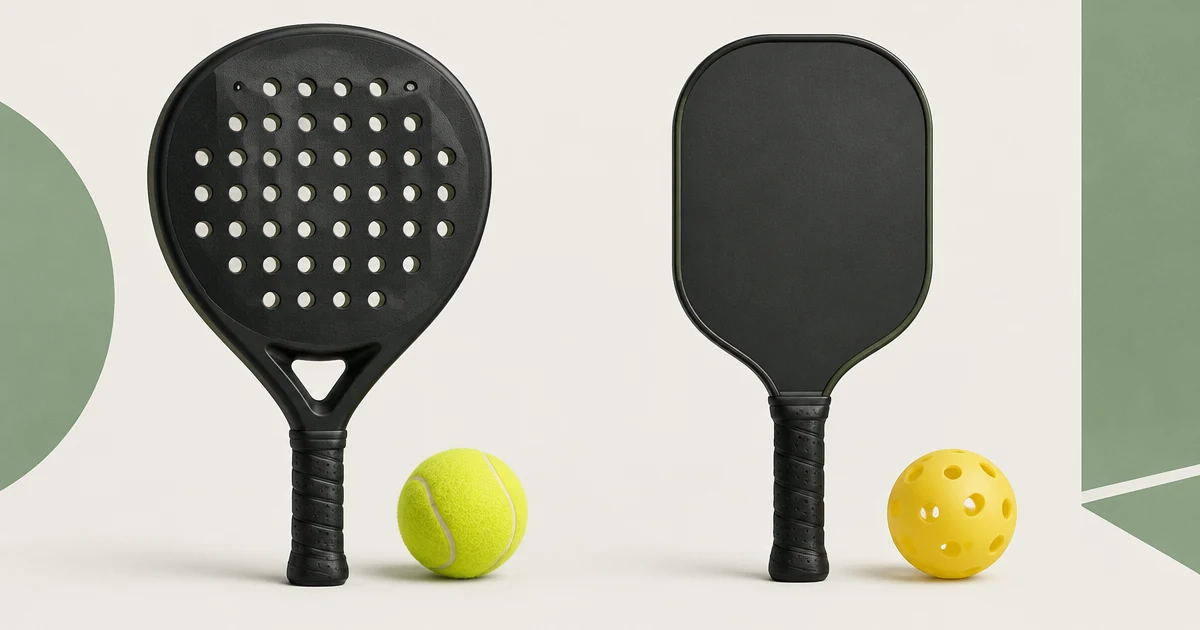
A padel racket has a thick head with holes. The ball is felt-covered rubber, similar in appearance to a tennis ball. Ask for padel balls when buying or renting equipment.
A pickleball paddle has a continuous hitting surface. The holes are in its plastic ball. Paddles come in different weights and constructions, with materials including fibreglass, graphite and carbon fibre.
For a first session, book somewhere that lends or rents the correct equipment. You can choose a racket or paddle after finding out whether you want to keep playing.
Which is easier for beginners?
If you have no racket-sport experience and both sports offer equally convenient beginner sessions, we would start with pickleball. The smaller court and lack of wall rebounds give you fewer ball paths to judge.
You still have to learn the kitchen, the opening bounces and the scoring. Being able to start a rally quickly does not make accurate volleys or a controlled short game easy.
Padel adds rebound judgement. New players often swing at a difficult ball before the glass has had a chance to return it into a better position. A coached introduction gives you somewhere to practise that without trying to work it out in a competitive match.
If you already play tennis, padel's scoring will feel familiar. If you enjoy judging balls off walls, that part of padel may appeal immediately.
Choose a session where the other players are also learning. Spending an hour watching experienced players hit past you is a poor introduction to either game.
Is pickleball cheaper than padel?
It can be, but compare actual bookings in your area.
At The Padel Yard in London, the advertised non-member rates are £60 an hour for padel and £20 for pickleball.
| Published court rate | Padel | Pickleball |
|---|---|---|
| One court for one hour | £60 | £20 |
| Each player's share with four players | £15 | £5 |
Padel costs three times as much at this club. These figures cover court hire at one London venue. The club also lists a 25p fee per player for MATCHi split payments.6
When comparing your own options, check:
- Whether the price is for the whole court or one person.
- How long you can use the court.
- Whether racket or paddle hire and balls are included.
- Whether you need a membership or pay a booking fee.
- Whether the advertised session involves rotating off court.
A two-hour open-play session may include waiting between games. A private one-hour booking reserves the court for your group. Compare the amount of play you expect to get, not just the cheapest ticket.
If you play pickleball singles, split a private court fee between two people when working out your cost. The four-player figure above applies to doubles.
Which should you try first?
| Your situation | A sensible first choice |
|---|---|
| You have one friend and want to play singles | Pickleball |
| You want doubles built around wall rebounds, lobs and overheads | Padel |
| You have no equipment or regular playing group | A coached beginner session that supplies equipment and places you with other learners |
| Your friends already play one sport every week | Join their beginner-friendly game before buying equipment for the other sport |
| Weekly cost is the main constraint | Compare local court shares, equipment hire and access to open-play sessions |
If both sports are available nearby, borrow the equipment and try each with players at your level. Notice whether you enjoy reading rebounds in padel or working around the kitchen in pickleball. Then check whether the session fits your weekly schedule and budget.
Our guide to starting padel covers booking, equipment and what to practise in your first sessions.
Frequently asked questions
- Are padel and pickleball the same sport?
- They have different courts, equipment and rules. Padel uses an enclosed court and playable wall rebounds. Pickleball uses a smaller marked court, a perforated plastic ball and a kitchen where you cannot volley.
- Is a padel court bigger than a pickleball court?
- Yes. Padel's 200 m² playing area is approximately 2.45 times pickleball's 81.75 m². This calculation compares the playing boundaries, excluding the surrounding space a facility needs.
- Can you play padel singles?
- The standard FIP game is doubles. Two people can practise together on a regular padel court. Pickleball has standard singles and doubles on the same court.
- Does padel have a kitchen?
- No. Padel has no non-volley zone. The kitchen belongs to pickleball, where it extends 7 feet from the net on each side.
Sources
- 1. International Padel Federation, Rules of Padel, applying from 1 January 2026, Court dimensions, equipment, serving, wall play and scoring.
- 2. USA Pickleball, 2026 Official Rulebook, Court and equipment specifications, serving, the two-bounce rule and kitchen rules.
- 3. USA Pickleball, Court construction guidance, Marked court dimensions and minimum and preferred total playing surfaces.
- 4. USA Pickleball, Scoring and positioning: side-out scoring, Point scoring and the three-number doubles score call.
- 5. USA Pickleball, 2026 rulebook change document, Rally scoring and the change allowing a receiving team to score the winning point.
- 6. The Padel Yard, Published court prices, Non-member hourly rates and the MATCHi split-payment fee. Prices checked 15 September 2026.
Related reading
- Padel vs tennis
The courts are closer in size than you might think. The bigger adjustment is what happens after a good shot hits the glass.
- How to start playing padel
What to book, what to bring, the rules you need for a first game and a five-session plan that gets a new player past the awkward first month.
- Padel court dimensions
A regulation padel court is 20 × 10 metres inside the walls. Here are the official line, net, enclosure and height measurements, plus the space a real facility needs.