
How to Start Playing Padel: Your First Game, Gear and Five-Session Plan
What to book, what to bring, the rules you need for a first game and a five-session plan that gets a new player past the awkward first month.
GuideBy PadelFormat Editorial TeamPublished Updated 13 min read
Quick answer
To start playing padel, find a nearby club and book a beginner group lesson or introductory clinic. Ask whether racket hire and balls are included, wear supportive court or tennis shoes, and arrive early enough for a 10-minute warm-up. You do not need to buy a racket, understand every wall rule or arrive with three experienced friends. Learn the serve, scoring, one-bounce rule and when the glass is live. That is enough for a first session.
TL;DR
- A beginner group lesson or introductory clinic is the best first booking for most people, and renting a racket for the first sessions is enough.
- Standard padel is doubles, so a normal court holds four players.
- Wear supportive court, tennis or padel shoes with secure lateral support.
- Ask whether the venue supplies rackets and padel balls before paying, and arrive 10 to 15 minutes early to warm up.
- Five rules cover a first game: underarm serve, diagonal service box, one bounce, floor before wall and tennis-style scoring.
- Enter the lowest genuine beginner level. Tennis experience does not automatically make you an intermediate padel player.
- Your first-session cost is the clinic fee or your share of the court, plus any racket hire and booking charge.
On this page
Book your first session in seven steps
| Step | What to do | What to check |
|---|---|---|
| 1 | Find a nearby padel venue | Look at the national federation directory, a booking platform and the club’s own site |
| 2 | Choose a beginner format | Look for “intro”, “absolute beginner”, “learn padel” or “beginner clinic” |
| 3 | Check what is included | Ask about racket hire, balls, coaching, court time and the number of players |
| 4 | Book the right surface and time | Confirm indoor or outdoor, footwear rules and the weather policy |
| 5 | Wear simple sports kit | Use secure shoes, comfortable clothes and the racket wrist cord |
| 6 | Arrive early | Allow time for check-in, racket adjustment and a short warm-up |
| 7 | Arrange the next session | Repeat the basics within a week or two while they are still familiar |
Padel venues are commonly found through national federation directories, club sites and booking services. FIP lists its affiliated national federations. USA Padel runs a US court directory, while the LTA maintains a British court finder. Playtomic and other booking platforms cover many clubs but no single directory contains every court.12
If you are choosing between racket sports, our padel vs pickleball guide explains how the walls, equipment, serving and scoring differ before you book.
Search more than one place before deciding there is no padel near you. New venues may appear on their own websites before a federation or booking directory is updated.
What should you book for your first padel session?
For most people, the best first booking is a group introduction with a coach. It gives you the rules, a working serve, safe court movement and players at roughly the same stage without the cost of a private lesson.
| First-session option | Best for | Main advantage | Watch out for |
|---|---|---|---|
| Beginner group lesson or clinic | Most first-time players | Coaching, other beginners and a planned session | Group size and racket hire vary by venue |
| Private lesson | A player who wants individual help or has specific access needs | The coach can adjust every drill and answer questions immediately | Usually the highest cost per person |
| Court with three friends | A group that already has four players | Flexible and the court cost is shared | Progress can be slow if nobody knows the rules or glass |
| Beginner social | A new player who wants regular partners | Easy route into the local club community | “Beginner” can cover a wide range, so ask who the session is for |
| Open match | A player who knows the scoring, serve and basic positioning | You can join without bringing a full group | A badly chosen level makes the game awkward for all four players |
A 60- to 90-minute session gives a coach time to explain the court, teach the serve and let the group play points. Session lengths differ by venue, so check the booking rather than assuming.
The six questions to ask before paying
- Is this session suitable for someone who has never played padel?
- Is the court fee included in the advertised price?
- Can I rent a racket, and are balls supplied?
- How many players and coaches will be on court?
- Is the court indoor or outdoor, and what happens if weather stops play?
- Are there membership, booking or cancellation charges?
Ask about accessibility, junior safeguarding or a recent injury when any of those affect the session you need. A useful club will tell you which class fits before it takes payment.
Can you start padel without three friends?
Yes. Book a clinic, beginner social or open match that accepts individual players.
Open-match systems let a player join alone and fill one place in a four-person game. Playtomic, for example, lets users search by place and time, join an existing match or create one, and choose between casual and competitive play. It also applies level ranges. Those are platform features, not universal rules for every club.8
For a first-ever session, a coached clinic is easier than guessing your level in a public match. After that, ask the coach or club host which social group fits. Local club groups can be more useful than an app in places where the player base is still small.
What equipment do you need for padel?
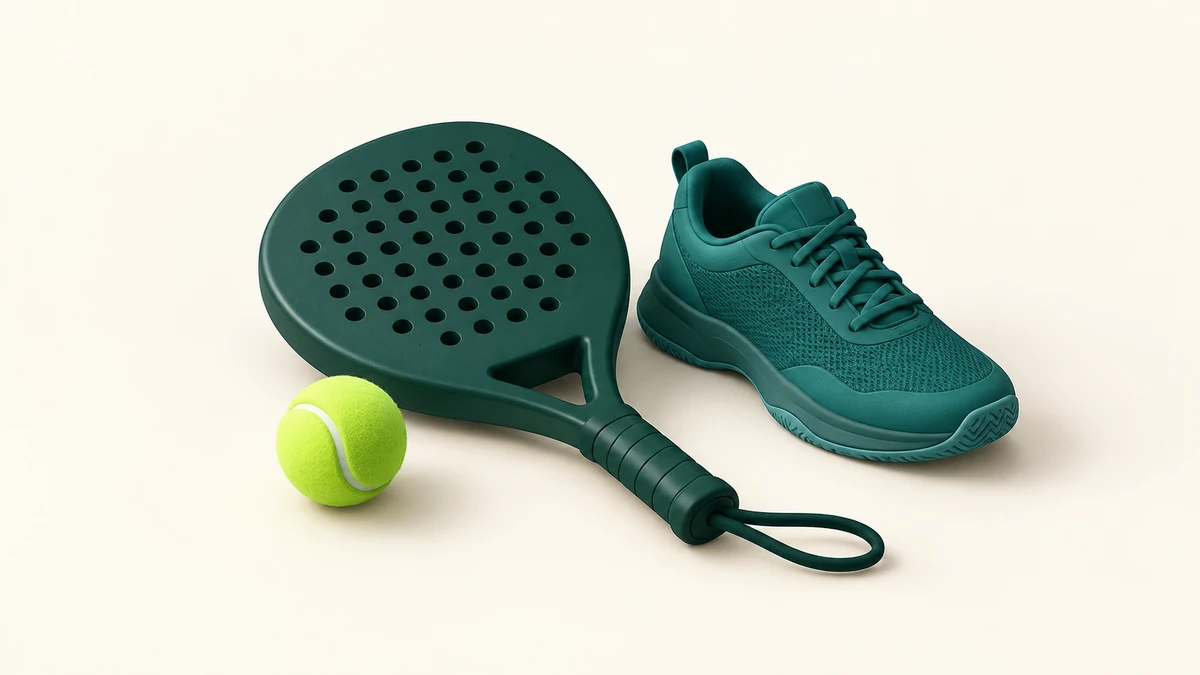
You need a padel racket, padel balls, suitable shoes, comfortable sports clothes and water. You can usually avoid buying padel-specific equipment for the first session if the venue rents rackets and supplies balls.
| Item | First session | When to buy |
|---|---|---|
| Padel racket | Rent or borrow one | After two or three sessions, once you can feel the difference between rackets |
| Padel balls | A coach usually has a basket; bring a tube only if you are playing without a coach | Beginner balls stay useful for many sessions, so one tube is plenty to start |
| Shoes | Court, tennis or padel shoes with lateral support | Buy a padel-specific outsole once you play weekly |
| Clothes | Ordinary comfortable sports kit | No padel-specific purchase needed |
| Water | Bring a bottle; needed every session | |
| Wrist cord | Comes with the racket and must be worn | |
| Grip and overgrip | Not needed if the rental grip is clean; buy when your own grip is dirty and slippery | |
A padel racket is solid and perforated rather than strung, and it carries a wrist cord that must be worn during play.1 Beginners are usually steered towards a controllable round or teardrop shape with a generous sweet spot rather than a heavy power racket. Once you are ready to buy, the racket chooser narrows the shortlist by shape, weight and balance.
What shoes should a beginner wear?
Use shoes that hold the foot securely during side steps, stops and turns. Padel or tennis shoes are the clearest choice. The LTA highlights lateral support and surface-appropriate traction as the main footwear needs.6
A clean, stable sports shoe can get you through an introductory session if the venue allows it. A worn running shoe with a tall, soft sole is a poor choice for repeated side-to-side movement. Ask the club which outsole suits its surface before buying a specialised shoe. The padel shoes database lists outsoles by surface.
The padel rules you need for a first game
The official rulebook is longer than a beginner needs. These five rules are enough to start a normal point correctly. They follow the FIP rules.1
1. Standard padel is doubles
Four players use a court that measures 10 metres by 20 metres. A net divides the court, and glass or solid walls plus metal fencing enclose it.
Singles padel courts exist at some clubs, but they are not the standard FIP doubles court.
2. Serve underarm after a bounce
Stand behind the service line, bounce the ball in your service area and hit it at or below waist height. At least one foot must stay in contact with the ground. Send the ball diagonally into the opposite service box. You get a second serve after a first fault.
The first serve of a game starts from the right. The server changes side after every point.
3. The return of serve must bounce
The receiver cannot volley the serve. Let it bounce in the service box and return it before a second bounce. During the rest of the rally, volleys are allowed.
4. The opponent’s floor must come before the wall
Your shot must cross the net and land on the opponent’s court before it touches their glass or fence. A direct hit into the opponent’s wall or fence is out.
On your own side, you may return the ball after it bounces and then hits the glass. You still have to hit it before the second floor bounce.
One small service exception matters. A serve that lands in the correct box and then reaches the glass can be good. A serve that lands and then touches the metal fence before the second bounce is a fault.3
5. Scoring usually follows tennis
Points are called 15, 30, 40 and game. The standard FIP option uses deuce and advantage at 40-all. The rulebook also permits alternative deciding-point formats, including versions of the golden point. Ask which format the coach, club or league is using before the match starts.
The first-rally cheat sheet
- Put the racket cord around your wrist.
- Serve diagonally after bouncing the ball.
- Let the serve bounce before returning it.
- Allow no more than one floor bounce on your side.
- Make the ball land on the opponent’s floor before their wall or fence.
- Let a deep ball pass you and rebound from your glass when that gives you more time.
- Call the score before serving.
What happens in a first padel lesson?
A useful first lesson should make you capable of playing a short game. There is no reason to cover every named shot in padel.
Expect the coach to cover:
- Court safety and the racket cord
- A comfortable ready position and basic grip
- A short forehand and backhand
- The underarm serve and return
- One-bounce and wall rules
- Simple scoring
- Where partners stand at the back and net
- A cooperative rally followed by points
You do not need a bandeja, víbora, kick smash or out-of-court retrieval in session one. Those shots make more sense after you can control a forehand, backhand, volley and lob.
The PadelFormat first five
Use your first five sessions to build one skill at a time. Start with the serve and scoring, then add wall play, net movement and full points.
| Session | Main job | Learn | A useful finish |
|---|---|---|---|
| 1. Start the point | Get a legal ball in play | Safety cord, scoring, serve, return and short groundstrokes | Play a service game without stopping to explain every point |
| 2. Defend the back | Stop fearing the glass | Ready position, forehand, backhand and one back-glass rebound | Rally ten controlled balls with at least one wall rebound |
| 3. Take the net | Learn the attacking position | Split step, compact volley and moving forward with your partner | Hold the net for three or more shots without swinging hard |
| 4. Change positions | Move from defence to attack | Lob, transition and a controlled overhead | Use a lob to win the net rather than trying a winner from the back |
| 5. Play the match | Join the pieces | Serve order, receiving sides, score, partner movement and match rhythm | Complete a full set or timed match and note two things to practise next |
Session one: start the point
Leave with one dependable serve rather than five service variations. A slow legal serve that starts the rally is more useful than a hard serve that misses.
Learn how the score moves and who serves. Use short swings. Your first success is a rally, not a winner.
Session two: defend the back
The glass is the part that feels least familiar to tennis, pickleball and badminton players. Start with predictable feeds that bounce once and reach the back glass. Give the ball space, turn with it and contact it in front after the rebound.
Do not try to use every wall. Learn one clean back-glass return first.
Session three: take the net
Padel teams often defend together near the back and attack together near the net. Move forward as a pair after a ball that gives you time. Keep volleys compact and aim away from the glass corners until your control improves.
Session four: change positions
The lob is the beginner’s route out of defence. A good lob sends the opponents away from the net and gives both partners time to move forward.
Learn a controlled overhead that keeps the ball in play. The hard smash can wait.
Session five: play the match
Play enough continuous points to feel the serving order, side changes and gaps between partners. Keep the score without asking the coach after every rally.
Afterwards, write down one technical problem and one positioning problem. Those two notes give the next lesson a job.
If you are deciding what you want from regular sessions, compare the research on why people play padel.
How should a beginner position themselves?
Think in pairs, not as two singles players sharing a court.
When defending, both partners are usually near the back of the court with enough room for the glass. When attacking, both move towards the net. One player at the net and one stranded at the back leaves a large diagonal gap.
Both partners also need a starting side and a plan for the ball down the middle. Our guide to padel positions covers where to stand and how to move as a pair.
Use these first-session rules:
- Move forward and back with your partner.
- Keep the racket in front when waiting.
- Use a short backswing because the court gives you less reaction time.
- Let deep balls reach the back glass instead of taking every ball early.
- Choose the middle when neither player has a clear call.
- Say “mine”, “yours”, “leave” and “switch” early.
- Use a lob when you need time to leave the back.
The LTA’s beginner guidance also puts control ahead of power and treats the lob, compact swings and use of the glass as core early skills.4
For stroke details, continue with PadelFormat’s padel techniques, padel shots and padel tips for beginners after the first booking is made.
How much does it cost to start playing padel?
There is no useful worldwide average. Venue, country, time, indoor cover, coaching and membership all change the price.
Use this first-session formula:
First-session cost per person = clinic fee or your share of the court + racket hire + booking charge
Balls may be included in a clinic. A private court booking may require the group to bring or buy them. Shoes and sports clothes cost nothing extra if you already own suitable kit.
Two real examples show why the booking label matters:
| Market and period | Published court price | Four-player share | What it measures |
|---|---|---|---|
| Britain, 2025 | £27 per court per hour | About £7 per person | LTA average off-peak booking |
| United States, Q2 2025 | $80 outdoor or $100 indoor per court per hour | $20 or $25 per person | National average peak booking in the State of Padel in the US study |
Sources: LTA and Misitrano Consulting.1011 The four-player US shares are PadelFormat calculations.
These examples cover different countries and booking periods: one measures off-peak bookings and the other peak bookings.
Both examples exclude coaching, membership, racket hire and booking fees. Check the live venue price before travelling. The UK padel statistics and US padel statistics pages explain the wider market data behind each figure.
Work out your court fees and first purchases with these example yearly padel budgets.
The cheapest sensible first session
Look for a group introduction that includes the court, coach, racket and balls. If that is unavailable, share an off-peak court with three friends and ask one experienced player to spend the first 15 minutes on the rules.
The cheapest booking is not good value when nobody brings balls, the racket desk is closed or the session level is wrong. Check the full cost and what is included.
How do padel levels work?
There is no universal beginner number. Clubs, leagues and apps use different scales.
Playtomic uses a 0 to 7 rating system, while other organisations use their own categories or larger numerical ranges. A number only makes sense inside the system that issued it.9
For your first booking:
- Choose “absolute beginner”, “introductory” or the lowest genuine playing level.
- State that you have never played padel, even if you play tennis or pickleball.
- Ask for a club assessment when the labels are unclear.
- Do not raise a self-rating to enter a convenient match time.
- Treat a platform estimate as a starting point, not a permanent verdict.
Tennis experience may help with tracking a ball and basic racket contact. It can also bring a long swing, too much pace and reluctance to use the glass. Let the coach see your padel game before choosing an intermediate group.
Are you ready for an open match?
You do not need to be good. You need to be able to keep a beginner match running without stopping after every point.
- You can serve underarm into the correct diagonal box.
- You can let the serve bounce and return it.
- You know how the score is called and who serves next.
- You can play one ball off your own back glass.
- You can hit a compact volley from the net.
- You can lob when you are pushed back.
- You can move forward and back with a partner.
- You can play twenty minutes without stopping to ask for the rules.
If most of that list is comfortable, book the lowest open-match level and say it is one of your first matches. Warm up before the first point and build the pace gradually.7 Read our guide to padel injuries if you are returning from a complaint.
Common beginner mistakes
- Buying an advanced racket immediately
- The words “pro” and “power” do not make a racket easier to use. Rent first and choose for control.
- Booking a level because the time is convenient
- A mismatched open match is frustrating for the beginner and the other three players. Ask the club where first-timers belong.
- Hitting with a long tennis swing
- The enclosed court reduces reaction time. Short preparation and clean contact keep more balls in play.
- Trying to smash every high ball
- The glass can send a hard shot back. A controlled overhead or lob usually teaches more in the first month.
- Refusing to let the ball reach the glass
- The back wall is not the edge of the point. After a floor bounce, it can give you time and space to return the ball.
- Moving alone
- Rushing to the net while your partner stays back opens the middle and diagonals. Move as a pair.
- Wearing the wrist cord loosely
- The cord belongs around the wrist during play. It is an official safety requirement.
- Starting with too much court time
- Three hard matches in a weekend can be a large jump for a new player. Build frequency and intensity one step at a time.
Frequently asked questions
- Is padel easy for a complete beginner?
- Most beginners can start a rally in their first session because the serve is underarm and the racket has a short handle. Reading the walls, moving with a partner and choosing the right shot take longer.
- Do I need a lesson before playing padel?
- No. Four friends can rent a court and learn the basic rules. A beginner group lesson is the smoother first booking because a coach can teach the serve, glass and positioning before habits form.
- Can I play padel alone?
- A standard match needs four players. You can attend a one-to-one lesson, practise permitted solo drills or book a singles court where one exists. For normal doubles, join a clinic, social or open match if you do not have three partners.
- Do I need tennis experience?
- No. Tennis, squash, badminton and pickleball experience may help with coordination, but none is required. Tennis players still need to shorten the swing, use the walls and move with a partner.
- Can I use a tennis racket for padel?
- No. Padel uses a solid perforated racket with a wrist cord. Rent a padel racket for the first session rather than buying one immediately.
- Can I use tennis balls for padel?
- Use padel balls when possible. Tennis balls have different pressure, size and bounce specifications, so they change the way the court and glass play.
- What should I wear for my first padel lesson?
- Wear comfortable sports clothes and secure court or tennis shoes. Bring water. Ask the venue about its surface and footwear rules, especially for indoor courts.
- How many people do you need for padel?
- Standard padel is played by four people in two teams. A group lesson may contain more players rotating through drills, and some venues have non-standard singles courts.
- How long is a padel session?
- Club bookings commonly use fixed slots such as 60 or 90 minutes, but there is no single worldwide session length. A full best-of-three-set match lasts as long as the score requires. Read the booking details before arranging travel.
- How much does a first padel game cost?
- Add your share of the court or clinic fee, racket hire and any booking charge. Balls may be included. Published examples range from about £7 per person for an average British off-peak court in 2025 to $20 or $25 per person for average US peak outdoor or indoor court time in Q2 2025. Those figures use different markets and booking periods.
- What level should a first-time padel player choose?
- Choose absolute beginner, introductory or the lowest genuine category. Rating numbers differ between clubs and apps. Tell the organiser that you have not played padel before and ask for an assessment if the label is unclear.
- When should I buy my first padel racket?
- Buy after two or three sessions if possible. Try more than one rental or demo and look for a controllable round or teardrop racket with a comfortable balance and generous sweet spot.
- What should I learn first in padel?
- Learn a legal serve, a return, scoring, one back-glass ball, a compact volley, a lob and how to move with your partner. Those skills are enough to join a genuine beginner match.
Sources
- 1. International Padel Federation, Rules of Padel, current official rules linked by FIP and accessed 29 August 2026.
- 2. LTA Padel, How to get started playing padel as a beginner, accessed 29 August 2026.
- 3. LTA Padel, Official padel rules explained, accessed 29 August 2026.
- 4. LTA Padel, Six padel tips for beginners, accessed 29 August 2026.
- 5. LTA Padel, How to choose a padel racket, accessed 29 August 2026.
- 6. LTA Padel, Padel clothing and footwear, accessed 29 August 2026.
- 7. LTA Padel, Padel warm-up exercises, accessed 29 August 2026.
- 8. Playtomic Help, How to sign up for an open match, updated 9 June 2026.
- 9. Playtomic, Padel levels explained, edited 8 May 2025.
- 10. LTA Padel, 860,000 players: LTA unveils latest figures on growth of padel in Britain, 25 March 2026.
- 11. Misitrano Consulting and Padel 22, The State of Padel in the US Report 2025 findings, 4 September 2025.
- 12. International Padel Federation, affiliated national federations and USA Padel Where to Play and LTA Padel court finder, accessed 29 August 2026.
Related reading
- Padel vs tennis
The courts are closer in size than you might think. The bigger adjustment is what happens after a good shot hits the glass.
- Padel tips for beginners
Play smarter from your first session: positioning, control, wall rebounds, teamwork, serving and picking the right gear.
- Best padel courts in the UK
Ten standout UK padel venues compared by court setup, weather protection, accessibility, facilities and playing experience.