
Padel Court Dimensions: Official Size, Walls, Height and Space Needed
A regulation padel court is 20 × 10 metres inside the walls. Here are the official line, net, enclosure and height measurements, plus the space a real facility needs.
GuideBy PadelFormat Editorial TeamPublished Updated 12 min read
Quick answer
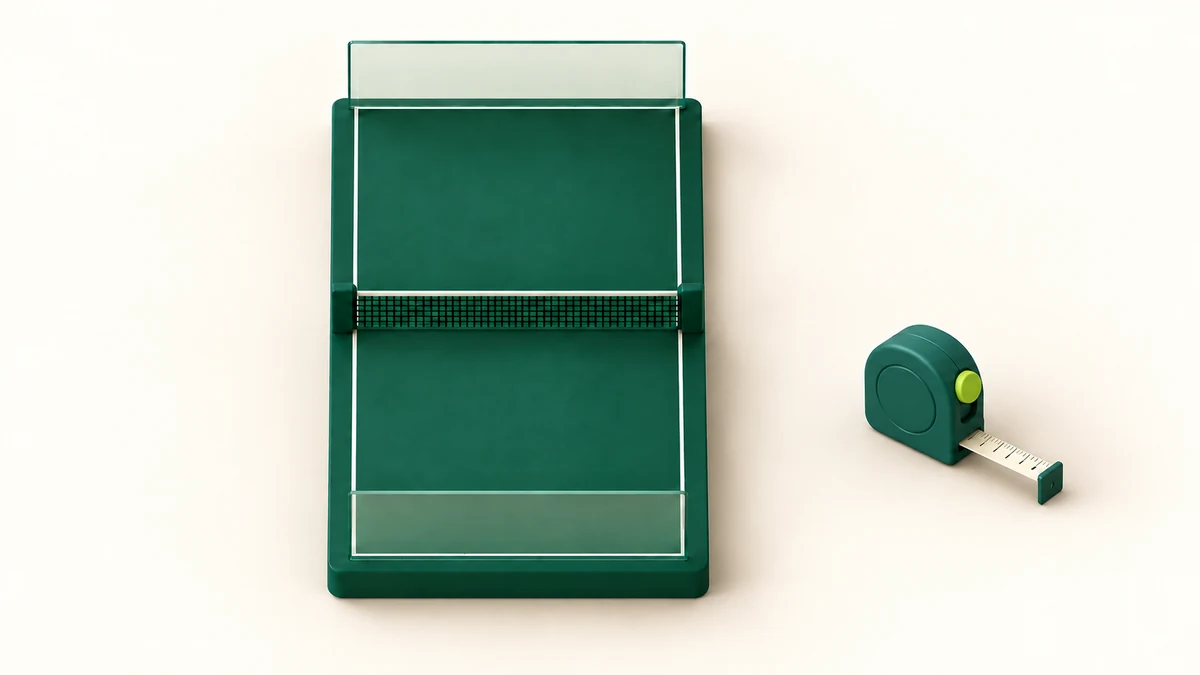
A regulation padel court is 20 metres long and 10 metres wide on the inside, giving a playing area of 200 square metres. In US measurements, that is 65 feet 7.4 inches by 32 feet 9.7 inches, or 2,153 square feet. The court needs at least 6 metres of clear height, although the International Padel Federation recommends 8 metres for new facilities. The 20 × 10 metre box does not include the structure, access, walkways or the safety space needed for out-of-court play.
TL;DR
- The official doubles court measures 20 × 10 metres inside the enclosure.
- Its interior playing area is 200 m², or 2,153 sq ft.
- The net is 0.88 m high at the centre and 0.92 m at the ends.
- Each service line sits 6.95 m from the net, leaving 3.05 m between the service line and back wall.
- End enclosures are 4 m high: 3 m of rebound wall with 1 m of metal fence above.
- The minimum clear height is 6 m. FIP recommends 8 m for a new court.
- Official out-of-court play needs two lateral safety zones, each at least 8 × 3 m.
- Those zones raise the clear playing-and-safety area from 200 m² to at least 248 m² before structure and circulation are counted.
- Artificial grass is common, but FIP also permits suitable cement and synthetic surfaces.
- FIP's official rules define the 20 × 10 m doubles court. Narrow commercial singles courts are a separate format.
On this page
Official padel court measurements at a glance
| Part of the court | Official metric measurement | Approximate US measurement |
|---|---|---|
| Interior length | 20 m | 65 ft 7.4 in |
| Interior width | 10 m | 32 ft 9.7 in |
| Interior area | 200 m² | 2,153 sq ft |
| Service line from net | 6.95 m | 22 ft 9.6 in |
| Service line to back wall | 3.05 m | About 10 ft |
| Court-line width | 5 cm | About 2 in |
| Net height at centre | 0.88 m | 2 ft 10.6 in |
| Net height at ends | 0.92 m | 3 ft 0.2 in |
| End wall | 3 m | 9 ft 10.1 in |
| End enclosure including upper fence | 4 m | 13 ft 1.5 in |
| Minimum clear height | 6 m | 19 ft 8.2 in |
| Recommended clear height for a new court | 8 m | 26 ft 3 in |
These measurements come from the FIP Rules of Padel effective from 1 January 2026. FIP states that court dimensions are measured from the inside.
Padel court plan
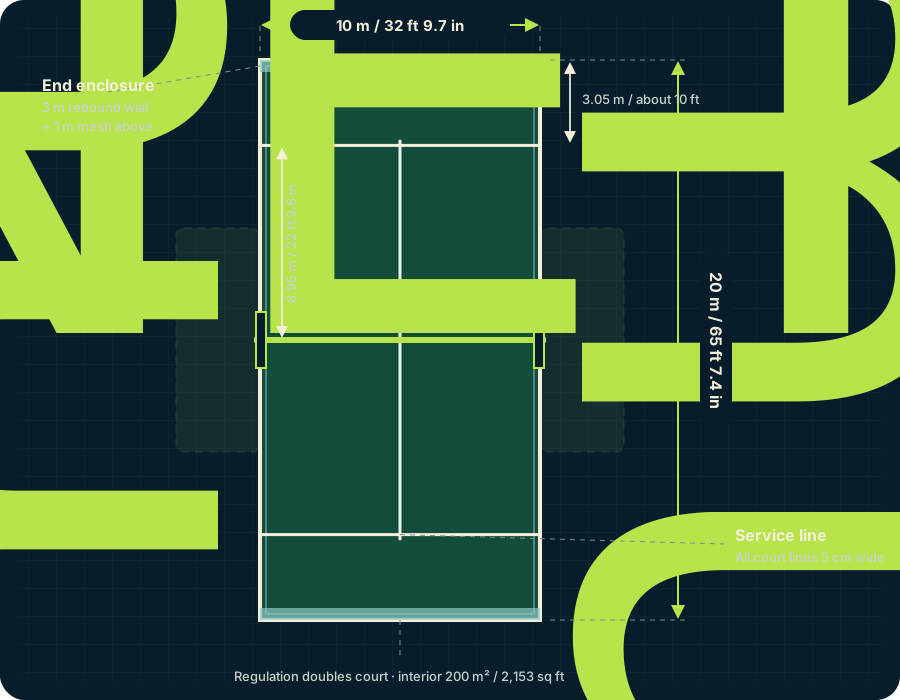
Accessible diagram data
| Diagram element | Position or size |
|---|---|
| Court boundary | Rectangle measuring 20 m long by 10 m wide internally |
| Net | Across the full 10 m width at the court midpoint |
| Service lines | Parallel to the net, 6.95 m away on both sides |
| Central service lines | Perpendicular to the net, dividing the area between each service line and the net into two equal boxes |
| Back areas | 3.05 m deep between each service line and its end wall |
| End enclosure | 3 m rebound wall with 1 m of metallic fence above |
| Out-of-court zones | One zone on each lateral side, 8 m long and at least 3 m wide |
How is a padel court marked?
The net divides the court into two equal 10 × 10 metre halves. A service line runs parallel to the net on each half, 6.95 metres away from it. A central service line then splits the space between the net and service line into two equal boxes.
Each service box is 5 metres wide and 6.95 metres long. That gives it an area of 34.75 m². The strip behind each service line is 3.05 metres deep, almost exactly 10 feet.
All court lines are 5 centimetres wide. FIP prefers white or black lines so they contrast with the surface. The central service line must continue at least 20 centimetres beyond the service line.1
The official rectangle carries a 0.5% dimensional tolerance. That figure equals 5 centimetres across the 10 metre width and 10 centimetres across the 20 metre length. It is an inspection tolerance, not permission to design a different-sized court.
Areas and distances within a 20 × 10 metre court
| Calculation | Result |
|---|---|
| Interior playing area | 200 m² |
| Exact diagonal of a 20 × 10 m rectangle | 22.361 m |
| Area of one service box | 34.75 m² |
| Area between both service lines and the net | 139 m² |
| Combined area behind both service lines | 61 m² |
Equal corner-to-corner diagonals are a basic way to check whether a rectangle is square. A contractor still needs a proper survey and the applicable court-homologation checks. A tape measure alone cannot verify foundations, glass, surface performance, drainage or lighting.
How high is a padel net?
The net is 10 metres long. It measures 0.88 metres at the centre and rises to 0.92 metres at both ends.
That 4 centimetre difference is deliberate. Quoting a single net height misses half the specification. The supporting posts may be no higher than 1.05 metres and must have rounded edges.1
The padel net is lower than a tennis net at the centre. Tennis uses 0.914 metres, while padel uses 0.88 metres. The difference is only 3.4 centimetres, but the two nets are not interchangeable specifications.7
How high are the walls and fence?
The enclosure is part of the playing court. A ball rebounds differently from a hard wall and metal mesh, so their position changes the game.
At both ends, the enclosure is 4 metres high. The lower 3 metres form the rebound wall. The upper metre is metallic fence.
FIP permits two side-enclosure layouts:
| Official side layout | Rebound-wall shape | Metal-fence height |
|---|---|---|
| Variant 1 | A stepped return at each end, first 3 m high × 2 m long, then 2 m high × 2 m long | Completes the centre to 3 m and the end zones to 4 m |
| Variant 2 Crystal | A flush 3 m-high wall running 4 m from each end, without the 2 m step | Reaches 4 m over the outer 2 m at each end |
FIP permits glass, brick or another transparent or opaque wall material, provided the inside face is hard, smooth, consistent and produces a uniform rebound. Glass installations must meet the applicable tempered-glass and court-homologation standards.1
The metallic fence must form a flat vertical surface. FIP specifies square electro-welded mesh with diagonal openings from 5 to 7.08 centimetres. Welds and edges must not expose players to cuts or scratches.
Is a panoramic padel court a different size?
Panoramic courts keep the regulation 20 × 10 metre playing area. The term describes the enclosure and the view through it.
A panoramic court usually removes or reduces intermediate posts around the glass, particularly at the ends. That improves sightlines for players, spectators and cameras. The internal rectangle remains 20 × 10 metres and the rebound surfaces still have to meet the rules.
The frame design changes structural loads. A cleaner view is not a reason to skip site-specific wind, foundation and glass calculations.
How much ceiling height does an indoor padel court need?
FIP sets a minimum unobstructed height of 6 metres across the whole court. Lights, beams, ducts and roof bracing count as obstructions.
For a new facility, FIP recommends at least 8 metres of clear height throughout. A building being designed now should target 8 metres. Six metres is the rulebook floor. Higher lobs play better under an 8 metre clearance and there is more room to position lights outside the ball path.1
Light projectors positioned within the vertical projection of the court must sit at least 6 metres above the surface. FIP again recommends 8 metres for new facilities.
How much total space does one padel court need?
The 200 m² figure covers the playing area, not the full site footprint.
The 20 × 10 metre measurement covers only the playable interior. It excludes the thickness of the frame and glass, foundations, drainage, paths, accessible routes, maintenance clearance, seating, storage and building structure.
If the court allows official out-of-court play, FIP requires an obstacle-free safety zone outside each lateral side. Each zone must be at least 8 metres long, 3 metres wide and 3 metres high. A width of 4 metres is recommended.1
Example total space with outer clearance
| Space being counted | Calculation | Clear area |
|---|---|---|
| Court interior only | 20 × 10 m | 200 m² / 2,153 sq ft |
| Court plus minimum out-of-court zones | 200 + 2 × (8 × 3 m) | 248 m² / 2,669 sq ft |
| Court plus recommended-width zones | 200 + 2 × (8 × 4 m) | 264 m² / 2,842 sq ft |
These are clear playing-and-safety areas, not complete site footprints. The safety zones sit beside the central court openings rather than forming a full border around every wall.
For a real-world reference, an LTA guide for education sites allows approximately 550 m² for two courts and 1,150 m² for four. The leaflet does not define every shared space inside those allowances, so they work as early planning figures rather than a construction specification.
Buying or leasing land from the 200 m² number alone is how a court fits on a spreadsheet and fails on a site plan.
Can three padel courts fit on one tennis court?
Three regulation padel courts do not fit inside one doubles tennis playing rectangle.
That tennis rectangle is 23.77 × 10.97 metres. One padel court fits within a larger tennis facility in many layouts, but two 20 × 10 metre padel boxes do not fit side by side or end to end inside the painted tennis dimensions.
The Sports and Play Construction Association gives the more defensible rule of thumb: three padel courts can replace a block of two tennis courts when the surrounding space and site design allow it. That is three into two, not three into one.
Existing tennis bases also need to be surveyed for levels, gradients, drainage and structural suitability. The old surface being large enough does not prove it can carry a permanent padel structure.
Is a padel court really one-third the size of a tennis court?
It depends on which boundary is measured.
| Sport and boundary | Dimensions | Area |
|---|---|---|
| Padel, inside enclosure | 20 × 10 m | 200.0 m² |
| Tennis, doubles lines only | 23.77 × 10.97 m | 260.8 m² |
| Tennis, recommended recreational envelope | 34.73 × 17.07 m | 592.8 m² |
| Pickleball, court lines only | 13.41 × 6.10 m | 81.8 m² |
| Pickleball, preferred total playing surface | 19.51 × 10.36 m | 202.2 m² |
The 2026 ITF Rules of Tennis specify the doubles lines and recommend 5.48 metres behind each baseline and 3.05 metres beside each sideline for recreational and club play. The 2026 USA Pickleball rulebook separates its 20 × 44 foot court from the larger preferred 34 × 64 foot playing surface.
Padel is only 23.3% smaller than the marked doubles tennis rectangle. It is 66.3% smaller than the recommended recreational tennis envelope, which puts it close to one-third of the total area. The figures describe different boundaries.
Pickleball's court lines cover less than half the area of a padel court, while its preferred total surface is almost the same size as the padel interior.
What access openings does a padel court need?
Court access sits in the lateral sides, centred symmetrically around the net. A court may have one or two openings on each side, with or without doors.
| Access arrangement | Minimum opening | Maximum opening |
|---|---|---|
| One opening on a side | 1.05 × 2.00 m | 2.20 × 2.20 m |
| Two openings on a side | 0.72 × 2.00 m each | 1.10 × 2.20 m each |
If doors are installed, handles belong on the outside and must not project into the playing space. Public facilities also have to meet the applicable local accessibility and building requirements.
Out-of-court play changes the design. It needs two access points on each lateral side, clear safety zones and impact protection around the opening and net post. A venue that may host higher-level competition should decide this before ordering the enclosure.
What surface can a padel court use?
Artificial grass is common, but it is not the only surface allowed by the FIP rules. Cement and suitable synthetic materials are also permitted if the ball rebounds regularly.
FIP permits green, blue and terracotta surfaces, or similar tones. The floor should use one colour and contrast clearly with the walls and court lines.1
The surface must be flat enough that level differences stay below 3 millimetres under a 3 metre straightedge. On a surface without drainage, the maximum transverse drainage slope is 1% from the centre towards the outer edges.
Surface choice affects pace, grip, drainage and maintenance. A manufacturer name or turf colour does not replace performance testing.
How should an outdoor court be oriented and lit?
FIP recommends a north–south longitudinal axis for outdoor courts, allowing a range from north-northeast to north-northwest. That reduces the time players spend looking towards a low sun.
Lighting must be even and must not impair the view of players, officials or spectators. Light poles belong outside the court. A pole inside the out-of-court safety zone prevents that zone from being used for out-of-court play.
The rulebook's 1,000 lux figure is for vertical illumination used by television and filming. It is not a universal club-lighting target. A facility specification needs the correct competition class, uniformity, glare control, local planning limits and spill-light assessment.12
Why is a padel court 20 × 10 metres?
The size reaches back to the first court.
In 1969, Enrique Corcuera did not have room for a full tennis court at his home in Acapulco. He built an enclosed court measuring 20 × 10 metres with 3 metre walls. The FIP history of padel identifies it as the first padel court.3
The modern enclosure, mesh, access and safety rules are more detailed, but the original footprint survived. A private space constraint in Acapulco became the measurement used by clubs and tournaments around the world.
What should you check before building a padel court?
Survey the site before opening a court catalogue.
- Survey the full usable area, levels, drainage and access.
- Decide whether the court needs doors or official out-of-court play.
- Protect 8 metres of clear height on a new indoor or covered project.
- Commission site-specific foundation, wind-load and structural calculations.
- Specify the glass, mesh, fixings and surface against the applicable standards.
- Plan lighting, sun orientation, glare and spill before fixing column positions.
- Allow room to clean glass, maintain the frame and replace turf.
- Include accessible routes, emergency access, player circulation and safe spectator space.
- Check planning permission, noise, hours of use and local building rules.
- Have the finished court inspected against the standard it is meant to meet.
The SAPCA Code of Practice for the Construction of Padel Courts, fifth edition is a useful current UK starting point. SAPCA states that its document is guidance rather than a contract specification and recommends project-specific surveys and professional advice.4
Frequently asked questions
- What is the official size of a padel court?
- The official doubles court measures 20 metres long by 10 metres wide on the inside. That is 200 m², or about 2,153 sq ft.
- What are padel court dimensions in feet?
- The interior measures approximately 65 ft 7.4 in by 32 ft 9.7 in. It is often rounded to 66 × 33 feet, but those rounded figures should not be used to set out a regulation court.
- How high does a padel court need to be?
- The minimum clear height is 6 metres throughout. FIP recommends at least 8 metres for new facilities, with no lights, beams or other obstructions in that space.
- How high are padel court walls?
- The end rebound walls are 3 metres high, with 1 metre of metal fencing above for a total end-enclosure height of 4 metres. The legal side layouts combine wall and mesh at different heights.
- How far is the service line from the net in padel?
- Each service line is 6.95 metres from the net. That leaves 3.05 metres, almost exactly 10 feet, between the service line and back wall.
- How high is the padel net?
- The net is 0.88 metres high at the centre and 0.92 metres at the ends. It is 10 metres long.
- How much land is needed for one padel court?
- The interior needs 200 m², but that is not enough for a complete installation. Official out-of-court safety zones raise the clear playing-and-safety area to at least 248 m². Structure, foundations, circulation, access, maintenance and other site uses need more.
- Can you build a padel court under a 6 metre roof?
- Six metres of unobstructed height is the official minimum. FIP recommends 8 metres for new courts. A beam or light below the clear-height line can make an otherwise tall building unsuitable.
- Do all padel courts have glass walls?
- FIP allows transparent or opaque rebound walls if they are hard, smooth, consistent and provide a uniform bounce. Tempered glass is the normal choice on modern courts because it preserves visibility.
- Is artificial grass required on a padel court?
- FIP also permits suitable cement and synthetic surfaces. Any surface must provide a regular bounce and meet the relevant level, slope and performance requirements.
- Are singles padel courts regulation size?
- The FIP Rules of Padel define the 20 × 10 metre court used for doubles. Narrow singles courts exist at some venues, but they are not the standard court described in those rules. Check the venue's dimensions rather than assuming a universal singles specification.
- How many padel courts replace a tennis court?
- There is no safe universal ratio because tennis facilities have different surrounds and orientations. SAPCA says three padel courts can replace a block of two tennis courts where the site allows. The common claim that three padel courts fit on one tennis court confuses the tennis lines with the full facility.
Sources
- 1. International Padel Federation, Rules of Padel, review of application 1 January 2026, accessed 1 September 2026.
- 2. International Padel Federation, Documents, current governing-body document index, accessed 1 September 2026.
- 3. International Padel Federation, History of padel, accessed 1 September 2026.
- 4. Sports and Play Construction Association, Codes of Practice, including The Construction of Padel Courts, fifth edition, September 2025, accessed 1 September 2026.
- 5. Sports and Play Construction Association, Padel Tennis facility guidance, accessed 1 September 2026.
- 6. LTA, Developing Padel Facilities on Education Sites, facility-planning guide, accessed 1 September 2026.
- 7. International Tennis Federation, 2026 Rules of Tennis, court dimensions and recommended surrounds, accessed 1 September 2026.
- 8. USA Pickleball, 2026 Official Rulebook, court and total playing-surface dimensions, accessed 1 September 2026.
Related reading
- What is padel
Padel is normally played by four people on an enclosed court. Here's how the walls, serve and scoring actually work, and what you need to show up to your first match without looking lost.
- Best padel courts in the UK
Ten standout UK padel venues compared by court setup, weather protection, accessibility, facilities and playing experience.
- How to start playing padel
What to book, what to bring, the rules you need for a first game and a five-session plan that gets a new player past the awkward first month.